!Portrait of Hong Xiuquan as the Heavenly King, painted in traditional Chinese style
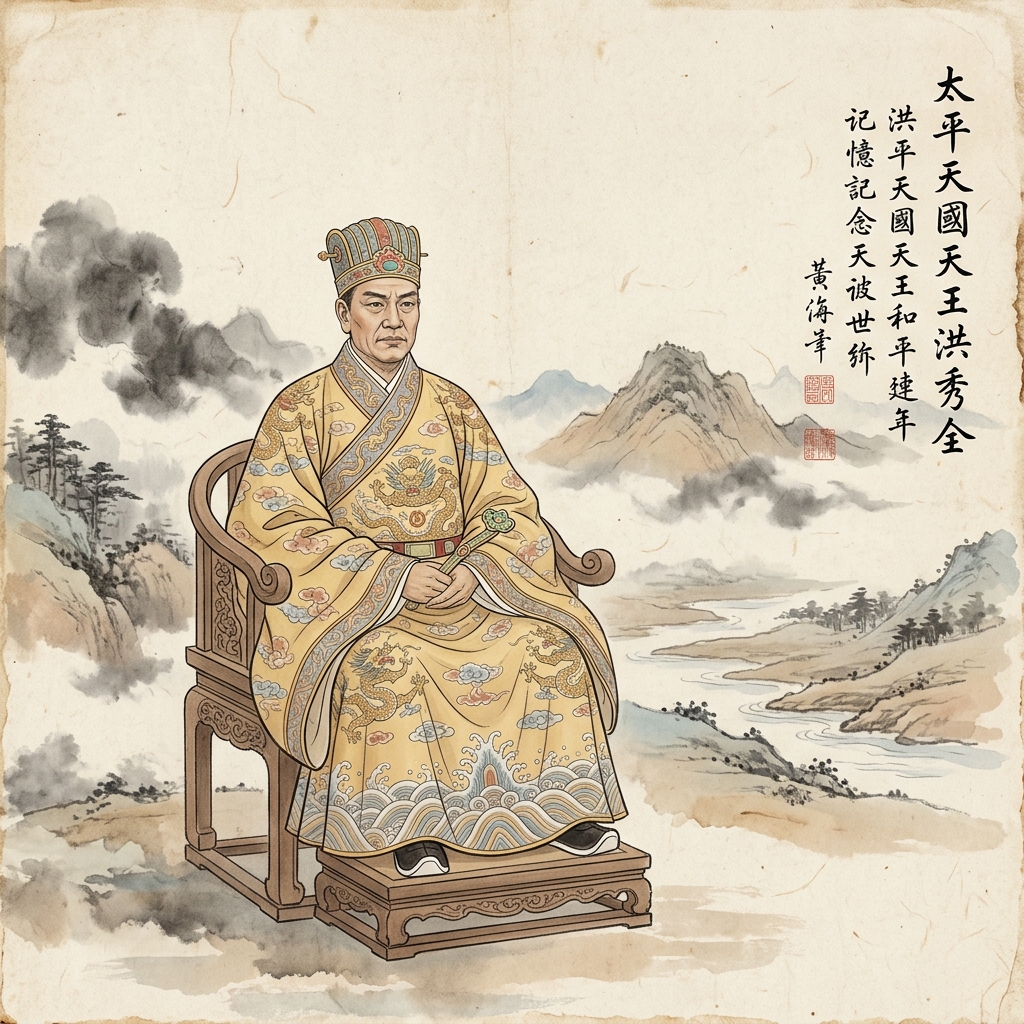
Hong Xiuquan, 洪秀全 (Hóng Xiùquán), was the founder and Heavenly King, 天王 (Tiānwáng), of the Taiping Heavenly Kingdom. He was born on 1 January 1814 in Fuyuan village, 福源水, Hua county, 花县, Guangdong, into a Hakka family of modest means. He died on 1 June 1864 in Tianjing, 天京, as Qing forces closed in on the capital. His followers treated him as the second son of Shangdi, younger brother of Jesus, and the chosen ruler of the Heavenly Kingdom. His enemies treated him as a rebel chief and false prophet.[1]
Early life and failed examinations
Hong's family invested in his education. Success in the civil service examinations could bring office and honour to the family and community. A village relative who passed the examinations could protect the community against official exactions and enhance local status. Hong was a bright student and began sitting the examinations at the county level.[1]
He passed the county-level exam in 1827, at age thirteen, but failed the provincial juren examination three times — in 1836, 1837, and 1843. The civil service examination system was intensely competitive — tens of thousands of candidates competed for a few hundred degrees — and Hong, for all his ability, could not advance past the county level. The crucial failure came in 1837, when Hong travelled to Guangzhou, 广州, for the provincial examinations. After failing again, he suffered a severe illness — fever, hallucinations, visions — that lasted approximately forty days. In his visions, which he later described in Taiping texts, he was carried to heaven, where he met an aged man on a throne who gave him a sword and a seal, and a middle-aged man who instructed and assisted him. The aged man lamented that the world was full of demons and commanded Hong to destroy them.[1][2]
Hong returned home, recovered, and resumed a normal life. He taught in village schools and continued to sit the examinations — without success. The visions receded into memory. What transformed them into a political programme was a Christian tract he had received in Guangzhou.
Liang Afa's tract and the reinterpretation
In 1836 or 1837, during one of his examination trips to Guangzhou, Hong was given a copy of 劝世良言 (Quànshì liángyán, "Good Words for Exhorting the Age"), a collection of sermons and biblical excerpts by Liang Afa, 梁发, the first Chinese Protestant evangelist. Hong glanced at the tract at the time but did not study it. In 1843, Hong's cousin Li Jingfang, 李敬芳, looked at the tract and suggested it might explain Hong's visions. Hong then read it carefully.[3][2]
The tract gave Hong the key. The aged man on the throne was Shangdi, 上帝, the Heavenly Father. The middle-aged man who assisted him was Jesus, the Heavenly Elder Brother, 天兄 (Tiānxiōng). Hong himself was the second son, called to destroy demons — the idols, false gods, and ultimately the Manchu rulers who tolerated and promoted demon worship. The tract's language of divine kingship, judgment on idolaters, and the duty to worship the one true God fused with Hong's classical education, his examination failure, and his anti-Manchu disposition to produce a potent religious-political synthesis.[3]
Hong and Li Jingfang baptised themselves according to their understanding of the tract. Hong composed his first religious poems. He began to preach to family and neighbours.
The visionary becomes the Heavenly King
In 1847, Hong travelled to Guangzhou and studied briefly with the American Baptist missionary Issachar Jacobs Roberts. The study was short — about two months — but exposed Hong to biblical texts more systematically than Liang Afa's tract had done. Roberts declined to baptise Hong, later claiming he doubted Hong's orthodoxy.[1]
Hong then returned to Guangxi, where Feng Yunshan had been building the God Worshipping Society. Hong's presence — the visionary himself — gave the movement its central sacred figure. Hong composed the three early essays (原道救世歌, 原道醒世训, and 原道觉世训) that gave the movement its theological and political framework.[3][4]
On 11 January 1851, at Jintian, the God Worshippers raised rebellion. Hong took the title Heavenly King. At Yong'an in September 1851, he named the kings — Yang Xiuqing as Eastern King, Xiao Chaogui as Western King, Feng Yunshan as Southern King, Wei Changhui as Northern King, and Shi Dakai as Wing King. The movement was now a kingdom, and Hong was its sacred monarch.[2]
Heavenly King at Tianjing
After the capture of Nanjing in March 1853, Hong ruled from Tianjing. His authority came from sacred status, written proclamations, and the court hierarchy around him. He was not primarily a military commander or an administrator — those roles fell to Yang Xiuqing and the other kings. Hong's role was to embody the sacred legitimacy of the state, to issue edicts and religious texts, and to represent the Heavenly Kingdom to the world.[1]
But Hong's withdrawal into the palace after 1853 — he rarely appeared in public, communicated through intermediaries and written edicts, and devoted increasing time to religious composition — created a leadership vacuum that Yang Xiuqing filled. Yang's claim to speak with the voice of the Heavenly Father, discussed in the Taiping Ideology page, gave him an independent source of authority that ultimately challenged Hong's supremacy.
The Tianjing Incident of 1856 was the consequence. Hong ordered Wei Changhui to kill Yang Xiuqing; Wei did so, then killed thousands of Yang's followers; Hong then had Wei killed. The massacre destroyed the original leadership core and fatally damaged the Taiping state. Hong emerged from the incident as the sole surviving original leader — but the price was a court decimated by murder, a demoralised army, and a sacred monarchy that had demonstrated its capacity for fratricide.[1][2]
Final years and death
By the early 1860s, Qing armies under Zeng Guofan and his subordinates had surrounded Tianjing. Hong refused repeated advice to abandon the capital. Li Xiucheng, the Loyal King, proposed evacuating the court to Jiangxi or elsewhere to continue the struggle. Hong refused. He was the Heavenly King; Tianjing was the Heavenly Capital; to leave would be to admit that Heaven had withdrawn its mandate.[2]
In his final years, Hong produced a stream of religious proclamations — visions, poems, and edicts — that promised heavenly armies would descend to destroy the Qing. As the city starved, Hong reportedly ordered his subjects to eat "heavenly dew" (manna) and distributed grass and roots as sacred food. These reports, preserved in Qing sources and Li Xiucheng's confession, may be exaggerated, but they capture the paradox of Hong's final months: a sacred king sustained by visions as his earthly kingdom collapsed.
Hong died on 1 June 1864. The cause of death remains disputed. Most Western accounts say he committed suicide by poison. Some Chinese sources suggest he died of illness exacerbated by starvation. His body was buried inside the palace grounds. When Qing forces captured Tianjing on 19 July 1864, they exhumed his body, identified it, and burned it — an act of ritual annihilation intended to erase the Heavenly King from existence.[1][5]
How to understand Hong
Hong Xiuquan was a religious founder, a king, a failed examination candidate, a wartime ruler, and a symbol. He should not be reduced to madness, genius, or rebellion. His ideas moved hundreds of thousands of people because they gave cosmic meaning to the Qing crisis, local suffering, and anti-Manchu war. His sacred kingship created a state that challenged the Qing for fourteen years and controlled large portions of central China. His rule also produced a court that could not survive its own sacred politics — a monarchy that devoured its own kings, a prophet who could not delegate, and a kingdom that collapsed under the contradictions of its founding vision.
Related pages
- Taiping Ideology and Religion
- God Worshipping Society
- Origins
- Missionary Sources
- Taiping Heavenly Kingdom
- Tianjing Incident
- Tianjing
Sources used in this page
- Franz Michael, The Taiping Rebellion: History and Documents, Vols. I, II (Seattle: University of Washington Press, 1966, 1971).
- Luo Ergang 罗尔纲, Taiping Tianguo shi 太平天国史 (Beijing: Zhonghua shuju, 1991).
- Thomas H. Reilly, The Taiping Heavenly Kingdom (Seattle: University of Washington Press, 2004).
- Tobie Meyer-Fong, What Remains (Stanford: Stanford University Press, 2013).