!Traditional Chinese painting depicting the palace crisis of the Tianjing Incident of 1856
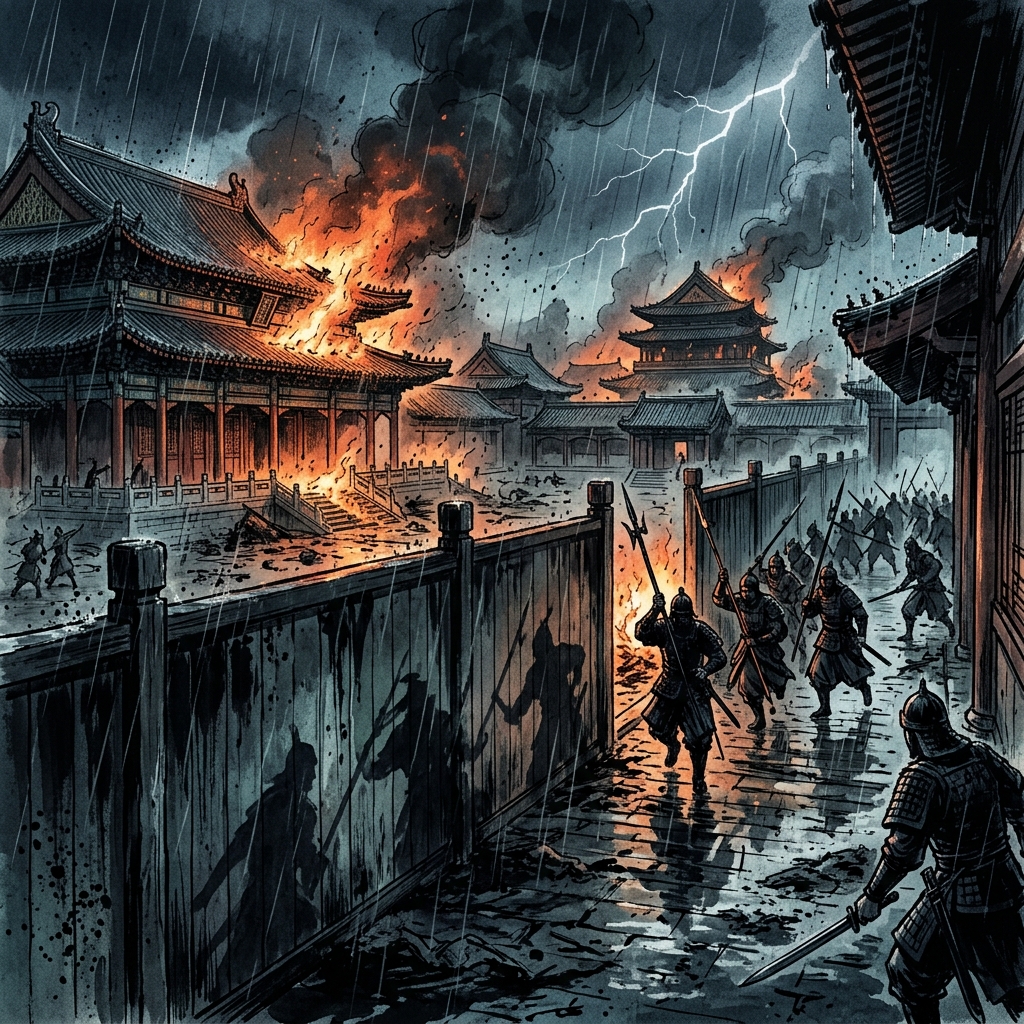
The Tianjing Incident (天京事变, Tiānjīng shìbiàn) of 1856 was the Taiping state's worst internal catastrophe: a palace coup, a massacre, and a leadership purge that destroyed the movement's founding coalition and fatally weakened its central government. In a sequence that spanned roughly three months — from the first days of September to late November 1856 — the Eastern King Yang Xiuqing was murdered, the Northern King Wei Changhui slaughtered thousands of perceived rivals, Wei himself was executed, and the Assistant King Shi Dakai fled the capital. The movement that had reached its military zenith by breaking the Qing siege camps around Tianjing in June 1856 was, by December, a hollowed-out court whose surviving commanders would never again fully trust the central leadership.[1]
The prelude: Yang Xiuqing's accumulation of power
The Taiping state's founding structure assigned supreme religious authority to Hong Xiuquan as Heavenly King (天王, Tiānwáng) and supreme executive and military authority to Yang Xiuqing as Eastern King (东王, Dōngwáng). The arrangement had a theological foundation: Yang, during the charismatic episodes of 1848 when Hong was absent from the God Worshippers, had claimed to speak in the voice of God the Heavenly Father. His pronouncements in trance were recorded as divine edicts and, within the Taiping system of sacred governance, were binding on all — including Hong himself.[2]
In the years after Nanjing's capture in 1853, Yang accumulated power to an extent that went far beyond his formal office. He directed all major military campaigns, controlled civil administration including the land registry and the treasury, and issued directives that treated the Heavenly King as a figurehead. Yang conducted himself with increasingly open assertions of equality with — or even superiority to — Hong. Luo Ergang notes that Yang began insisting on the title "Nine Thousand Years" (九千岁, Jiǔqiānsuì), only a step below Hong's "Ten Thousand Years" (万岁, Wànsuì), and used ceremonial forms that blurred the distinction between himself and the Heavenly King.[2]
Through 1855 and into the summer of 1856, Yang's subordinates began privately suggesting that he should demand to be recognized as "Ten Thousand Years" — that is, as co-equal with Hong. The military triumph of June 1856, when Taiping forces destroyed the Qing Jiangnan Great Camp that had besieged Tianjing for three years, removed the last external restraint on Yang's ambition. With the capital secure and his prestige at a peak, Yang summoned Hong to his palace and, in a confrontation described in several Taiping and Qing accounts, demanded recognition as fellow sovereign.
Hong's summons and Wei Changhui's arrival
The exact details of the confrontation between Hong and Yang remain obscured by the partisan nature of the surviving sources — all written after the killings — but the structural dynamic is clear. Hong could not accept equality without renouncing the monotheistic basis of his kingship: what made his rule legitimate was that he alone was the younger brother of Jesus Christ, and Yang was merely a human who channeled the divine voice. If Yang were now to be "Ten Thousand Years," the theological foundation of the state would collapse.
Hong sent secret messages to Wei Changhui (韦昌辉), the Northern King (北王, Běiwáng), who was then commanding troops in Jiangxi, and to Shi Dakai (石达开), the Assistant King (翼王, Yìwáng), who was also in the field. The messages ordered them to return to Tianjing to deal with Yang. Hong may also have sent a message to the Yan King Qin Rigang (秦日纲), a senior commander then stationed near Danyang.
Wei Changhui arrived at Tianjing on the night of 1 September 1856, traveling ahead of a force of some 3,000 trusted troops. Qin Rigang arrived simultaneously or very shortly afterward. The two men, with Hong's authorization, planned an immediate strike.[1]
The September massacre (2–4 September 1856)
In the early morning hours of 2 September 1856, Wei Changhui's troops surrounded the Eastern King's palace. Yang Xiuqing was seized and killed — accounts differ on whether he was beheaded or strangled — and his family and household staff were butchered. The killing did not stop at the palace walls.
Over the next two days, Wei Changhui and Qin Rigang directed the systematic slaughter of Yang's supporters, subordinates, family members, and anyone suspected of Eastern King loyalties. Michael estimates that between 2,000 and 6,000 people were killed inside Tianjing during this first wave of the purge — Phase 1, the initial massacre by Wei Changhui's forces.[1] Bodies were left in the streets. The Eastern King's extensive network of civil administrators, army officers, and palace staff was decapitated. In a single stroke, the Taiping state lost its most competent executive, its administrative cadre, and a large share of its institutional memory.
Wei assumed effective control of the capital. Hong, who had authorized the initial killing, found that his agent had become an independent danger. Wei reportedly began purging Taiping officials who had no connection to Yang but who posed potential threats to his own position.
Shi Dakai's arrival, flight, and Wei's execution (October–November 1856)
Shi Dakai arrived at Tianjing in late September or early October 1856, having been delayed by the distance from his command post in Hubei. The accounts of his arrival differ on details but agree on the essential sequence: Shi attempted to mediate, criticized the scale of the killings, and was warned that Wei intended to kill him as well. Shi fled the city at night, scaling down the city wall on a rope according to one account. Wei killed Shi's family — his wife, children, and household — who had remained in Tianjing.[2]
Shi Dakai retreated to Anqing, the Taiping's western stronghold, where he assembled a large army and threatened to march on Tianjing to remove Wei. But Shi did not need to march. Wei Changhui's violence, now clearly exceeding any mandate from Hong, had alienated the garrison, the bureaucracy, and what remained of the capital's population. In late November 1856, Hong ordered Wei's execution. Qin Rigang was also killed. Their heads were delivered to Shi Dakai's camp at Anqing as proof that the purge was ended.[1]
Aftermath and consequences
In late November 1856 Shi Dakai returned to Tianjing, where Hong appealed to him to assume the Eastern King's executive role. Shi attempted to restore order, but the trust that had sustained the founding leadership was gone. Hong, now deeply suspicious of all subordinates, elevated his incompetent brothers — Hong Renfa (洪仁发) and Hong Renda (洪仁达) — to positions of authority in the capital, deliberately undercutting Shi. In June 1857 Shi Dakai left Tianjing permanently at the head of an army estimated at 100,000–200,000 troops, effectively seceding from the central government. He would campaign independently through seven provinces until his capture and execution in Sichuan in 1863.[2]
The Tianjing Incident's consequences radiated outward from the capital. The Taiping's most experienced commanders — Yang, Wei, Qin, and eventually Shi — were all removed from the war within a year. The central government lost authority over field armies, which increasingly operated as autonomous commands under regional commanders like Li Xiucheng and Chen Yucheng. The movement's religious credibility, which depended on the claim that the Heavenly Father communicated with the faithful through Yang, was shattered. Qing forces, which had been reeling in the summer of 1856, regained the initiative and began the long process of reconquest.[3]
In the moral economy of the Taiping state, the incident was a disaster of collective meaning. A movement that had condemned the Manchu dynasty as corrupt and illegitimate had shown itself capable of palace murders, factional purges, and the slaughter of fellow believers. The rhetoric of the Heavenly Kingdom of Great Peace (太平天国, Tàipíng Tiānguó) was now stained with the blood of its own founders.
Debates
Scholarship is divided on the question of ultimate responsibility. Traditional Chinese historiography, following Luo Ergang, assigns primary blame to Yang Xiuqing's ambition: by demanding co-sovereignty, Yang violated the founding compact and forced Hong into defensive violence. Michael distributes blame more evenly, noting that Hong authorized a premeditated execution rather than attempting arbitration, and that the institutional structure of a theocratic monarchy made peaceful resolution impossible once two sacred voices clashed. Kuhn suggests a deeper structural explanation: the Taiping state fused charisma, military command, and religious authority without any constitutional mechanism for resolving succession or conflicting claims — the Tianjing Incident was the inevitable consequence of the founders' failure to institutionalize their revolution.
A separate controversy concerns numbers. Michael's lower estimate of 2,000–6,000 refers to Phase 1 — the initial massacre carried out by Wei Changhui's forces. Luo Ergang's figure of approximately 20,000 may encompass Phase 2 — the subsequent purges, executions, and revenge killings that continued for weeks after the first wave — and may still be conservative; some sources place the total at 10,000–40,000 when all phases are counted. The true scale is lost to the fragmentary nature of surviving records.
Related pages
Sources used in this page
- Franz Michael, The Taiping Rebellion: History and Documents, Vol. I (Seattle: University of Washington Press, 1966).
- Luo Ergang 罗尔纲, Taiping tianguo shi 太平天国史 (Beijing: Zhonghua Shuju, 1991).
- Philip A. Kuhn, Rebellion and Its Enemies in Late Imperial China: Militarization and Social Structure, 1796–1864 (Cambridge, MA: Harvard University Press, 1970).