!Traditional Chinese ink wash painting depicting the human cost of the civil war
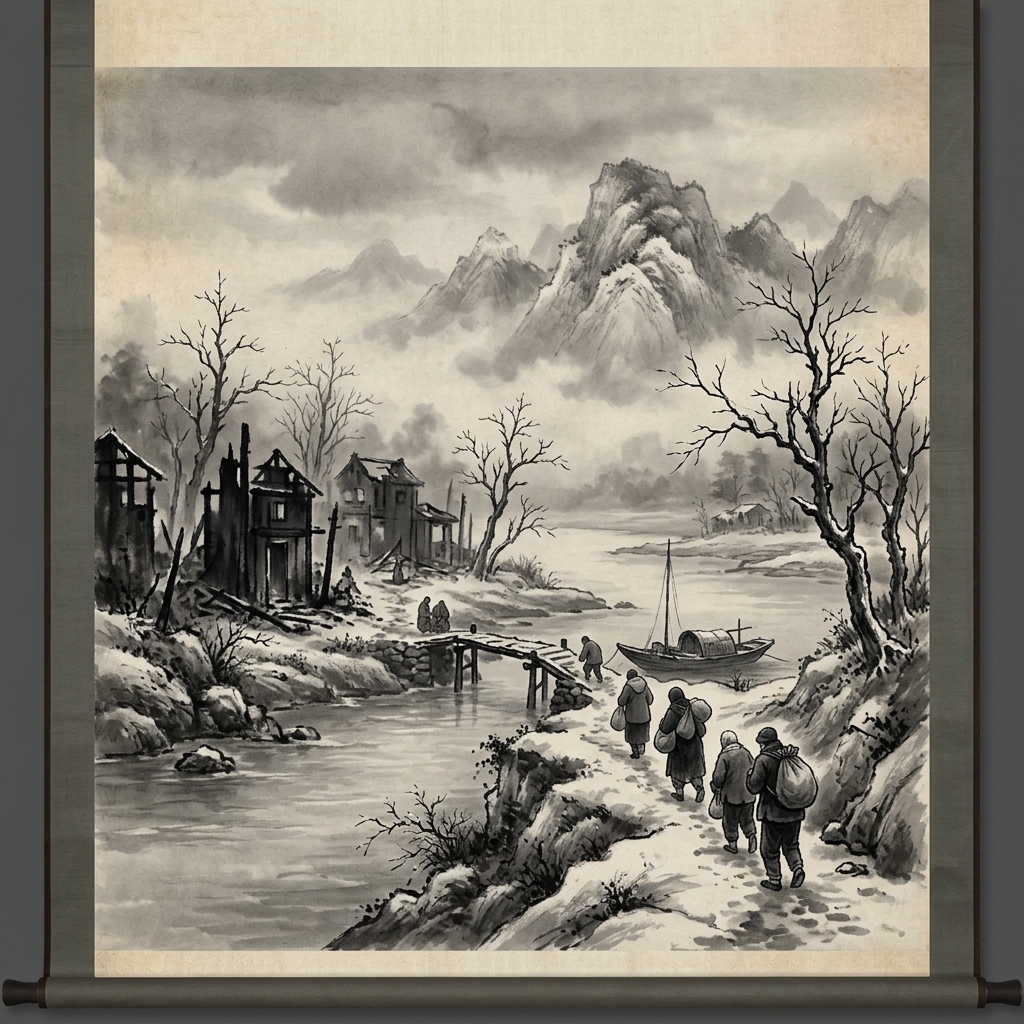
The Taiping war killed and displaced vast numbers of people across central and eastern China. The commonly cited estimate of 20 million deaths — a figure that appears in many reference works — should be understood as a broad order-of-magnitude estimate, not a precise count. The real human history lies in the regional patterns of death and survival, the causes of mortality, and the ways communities experienced and recorded loss.[1]
Why numbers are inherently uncertain
Casualty figures for the Taiping war face insurmountable obstacles. Qing population records were themselves unreliable before the war, and the war destroyed the administrative apparatus that produced them. Tax registers and population counts may show missing people, but "missing" includes the dead, refugees who never returned, migrants who resettled elsewhere, and households that were simply omitted from records by officials trying to meet unrealistic quotas. Gazettes compiled after the war sometimes recorded dramatic population drops — counties that had lost half or two-thirds of their registered population — but these figures mix mortality with displacement and administrative collapse in unknowable proportions.
The death toll came from multiple causes, each of which produced different kinds of evidence: battle deaths (recorded unevenly in military reports), massacre deaths (sometimes recorded by survivors, sometimes not), famine deaths (visible in grain price records and relief reports), disease deaths (epidemic disease flourished in conditions of crowding, poor nutrition, and disrupted sanitation), and deaths from the breakdown of local production and trade that left populations unable to feed themselves. No single source type captures the full range of mortality, and aggregating across sources compounds the uncertainties of each.[1]
Regional variation in death and survival
The war's human cost was distributed unevenly across the affected regions. The lower Yangzi — Jiangsu, Zhejiang, and southern Anhui — suffered the heaviest proportional losses. This was the zone of most intense and prolonged military operations: the initial Taiping descent on Nanjing (1853), the repeated campaigns around the capital, the eastern offensives toward Shanghai (1860, 1862), the Qing sieges of Taiping-held cities, and the final Xiang Army advance. Cities like Suzhou, Hangzhou, Changzhou, and Nanjing itself experienced siege, occupation, sack, and counter-sack across a decade. The countryside between cities was repeatedly traversed by armies that requisitioned grain, conscripted labor, and burned villages that resisted.[1][2]
The middle Yangzi — Hubei, Jiangxi, Hunan — experienced concentrated violence in the early and middle years of the war but recovered earlier in some areas, particularly Hunan, which was not occupied by Taiping forces for extended periods. Anhui was among the most devastated provinces, caught between the Taiping capital at Nanjing and the Qing base areas to the west. Some Anhui counties were so depopulated that postwar gazetteers describe landscapes with more wild animals than people.
Guangxi and Guangdong, the rebellion's birthplace, saw intense violence in the early 1850s that diminished after the Taiping departed. But banditry, local militia warfare, and residual violence continued for years, producing casualty patterns different from those in the main Yangzi theater.
Famine and disease
Famine was both a cause and a consequence of the war. Armies consumed grain that civilians had grown; sieges prevented food from reaching cities; the disruption of irrigation and transport networks reduced agricultural output even in areas not directly fought over. Local gazetteers record grain prices that reached multiples of normal levels, indicating the severity of food shortages. Meyer-Fong documents the relief efforts — gruel kitchens, grain distribution, charitable granaries — organized by gentry and officials, and their limitations: relief could save some but not all, and the capacity for organized charity was itself a casualty of the war.[1]
Disease accompanied war as it always has. Cholera, dysentery, smallpox, and other epidemic diseases spread through armies and refugee populations living in crowded, unsanitary conditions. The distinction between death from disease and death from war is artificial: disease was a direct consequence of the conditions the war created — the crowding, malnutrition, contaminated water, and breakdown of medical care.
Displacement
Displacement was one of the largest and least documented dimensions of the war's human cost. Millions of people fled their homes to escape armies, sieges, or occupation. Refugee flows followed the ebb and flow of military operations: civilians moved away from approaching armies, sometimes repeatedly, and many never returned. Some refugees found shelter in cities not yet touched by war; others became permanent migrants, resettling in Shanghai (whose population swelled during the war), in treaty ports, or in regions far from the conflict zone.
The war created a refugee crisis on a scale that premodern Chinese administration was not designed to handle. Relief was organized locally and unevenly. Refugee camps, when they existed, were improvised and often lethal — crowded, undersupplied, and prone to disease. Meyer-Fong notes that the displacement experience is harder to document than battle or massacre because refugees left fewer records. They appear in gazetteers as missing population, in relief records as recipients of aid, and occasionally in memoirs or family histories that record flight and survival.[1]
The Nanjing sack
The fall of Nanjing in July 1864 produced casualties whose exact scale is unrecoverable but whose severity is not in doubt. Zeng Guofan's Xiang Army forces under Zeng Guoquan breached the walls and fought through the city. Taiping defenders and residents — the distinction was often meaningless in the chaos of a sack — were killed in large numbers. Hong Xiuquan was already dead (he died in June, shortly before the city fell); his son, the young Heavenly King, was captured and executed. Li Xiucheng, the Loyal King, was captured attempting to escape and was executed after writing a long confession that remains a key source for Taiping history.
Contemporary foreign observers in Shanghai recorded estimates of tens of thousands killed in the Nanjing sack. Qing official sources minimized the numbers. The precise figure is unknowable, but Nanjing's population had been reduced by siege, starvation, and the sack itself to a fraction of its prewar level. The city remained a scarred and depopulated landscape for years afterward.[2][3]
The problem of the 20 million figure
The figure of 20 million deaths originates in nineteenth-century estimates — missionary reports, foreign newspaper accounts, and early Western histories — that aggregated battlefield deaths, famine deaths, disease deaths, and population decline into a single round number. Modern scholarship treats this figure as a rough estimate that communicates the war's magnitude without claiming precision. Some scholars suggest the true figure may be higher; others emphasize that population decline rather than death is the measurable phenomenon, and that displacement, reduced birth rates, and administrative recording failures contributed to the decline alongside mortality.[1]
Meyer-Fong's work shifts attention from the aggregate number — which can never be precise — to the human experiences that aggregate numbers obscure: the specific communities destroyed, the individuals buried, the survivors who rebuilt, the memories that persisted. The question is not only how many died but how the living made sense of the death that surrounded them.[1]
Debates
The casualty debate is partly methodological and partly political. Methodologically, historians disagree about the reliability of Qing population records and the appropriateness of extrapolating from local gazetteer data to national totals. Politically, the death toll has been used to make arguments about the Taiping's destructiveness (by Qing loyalists and their successors) or about the brutality of the Qing counterinsurgency (by nationalist and Communist historians). Both sides have an interest in the numbers.
A related debate concerns the relative contribution of different causes of death. Some historians emphasize battle and massacre deaths as the primary war mortality; others argue that famine and disease, driven by the collapse of agricultural production and the spread of epidemics, accounted for the majority of deaths. The evidence varies by region and period, and no single model fits the entire war.
Related pages
Sources used in this page
- Tobie Meyer-Fong, What Remains: Coming to Terms with Civil War in 19th Century China (Stanford University Press, 2013). The essential work on how communities experienced, recorded, and recovered from wartime death.
- Franz Michael, The Taiping Rebellion: History and Documents, Vol. I (1966). Campaigns and siege narratives.
- Luo Ergang, 《太平天国史》 (1991). Chinese-language political-military history with regional casualty data.