!Portrait of the Qing scholar-general Zeng Guofan, painted in traditional Chinese Gongbi style
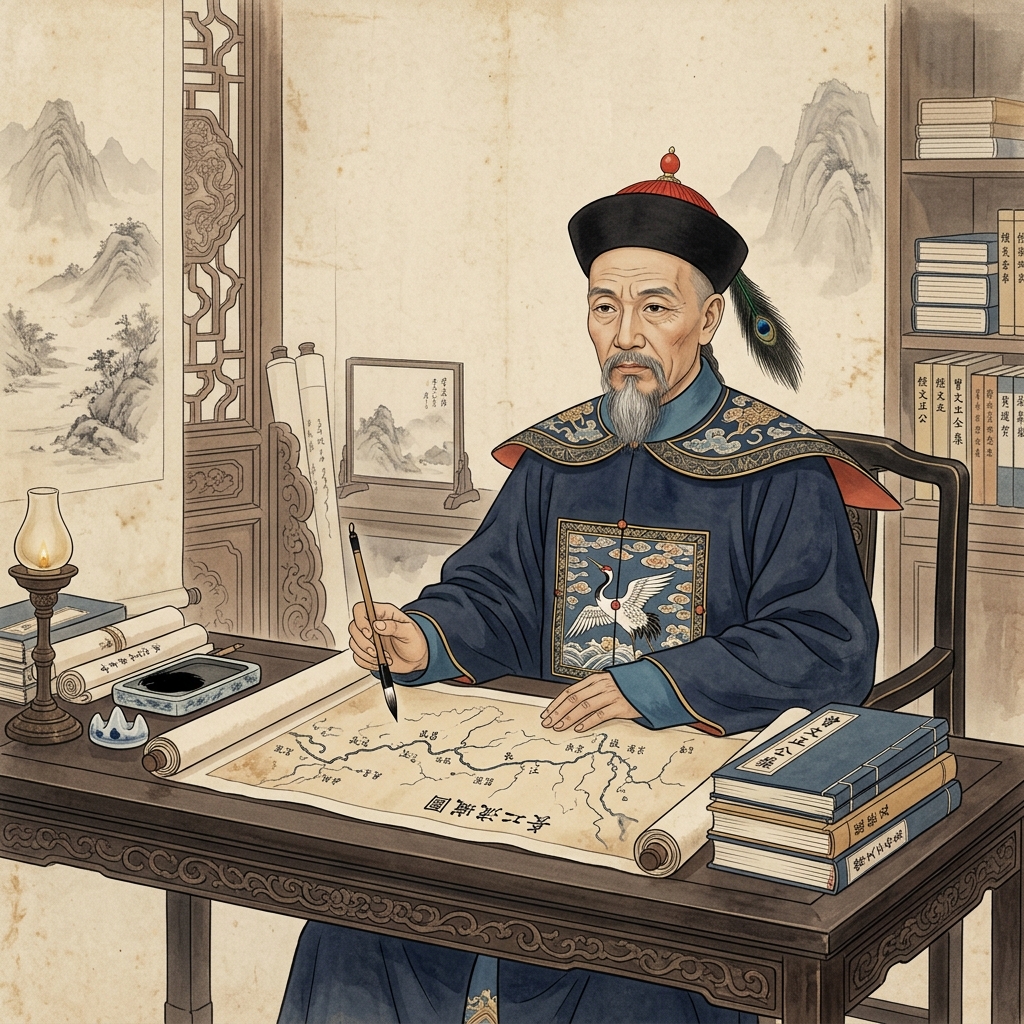
Zeng Guofan, 曾国藩 (Zēng Guófān, 1811–1872), was the Qing scholar-official who built the Xiang Army (湘军, Xiāngjūn), the force most responsible for the final defeat of the Taiping capital at Nanjing in July 1864. He was not a hereditary military man but a holder of the highest civil examination degree (进士, jìnshì) who, when the regular Banner and Green Standard armies collapsed, created a new kind of military organization rooted in provincial society, gentry networks, and personal authority. His methods saved the Qing dynasty and simultaneously transformed the distribution of military power within it, setting patterns that would outlast the empire itself.[1][2]
Birth and scholarly career
Zeng was born in 1811 in Xiangxiang (湘乡), a county in central Hunan. His family were landed gentry of no special distinction — his grandfather was a farmer who had risen modestly, his father a low-level degree-holder who never passed the higher examinations. Zeng was the family's hope. He proved a diligent student and an earnest Confucian. He earned the juren degree in 1834 and, after an initial failure, the jinshi in 1838 at the age of twenty-seven.[1][3]
His metropolitan career was that of a rising scholar-official. He served in the Hanlin Academy and was appointed to the Board of Rites (礼部, Lǐbù), where he worked on ritual and ceremonial matters. He was a serious diarist — his collected writings fill many volumes — and a committed practitioner of Confucian self-cultivation (修身, xiūshēn). He recorded his moral failings, his resolutions, his reading, and his reflections. The man who would later command the largest army in China and preside over horrific violence was, in his own self-understanding, a scholar striving for moral self-perfection.[1][2]
The mourning period and imperial commission
In 1852, Zeng was in mourning for his mother in Hunan — a period of withdrawal from official duties prescribed by Confucian ritual — when the court ordered him to raise local forces against the Taiping. The Taiping army had broken out of Guangxi, was moving through Hunan, and the regular Qing armies were proving incapable of stopping it. The instrument Zeng was authorized to use was the tuanlian (团练) militia system — a framework for local self-defense that had existed since the Jiaqing reign but had never been used to build a campaign army.[1][4]
Zeng understood from the beginning that local tuanlian — villagers organized to protect their immediate locality — could not defeat a disciplined enemy force like the Taiping armies. He needed something larger, better organized, and closer to a professional army. He used the tuanlian authorization to recruit, fund, and organize, but the product was a standing provincial army under unified command, not a collection of village watch groups.[1]
Building the Xiang Army
Zeng's military genius lay in organization, not battlefield tactics. He built the Xiang Army around principles that Kuhn identified as fundamental to late Qing militarization.
Regional recruitment (同乡招募, tóngxiāng zhāomù). Officers were chosen from Hunan scholar-gentry families — men who shared dialect, county origins, educational background, and often kinship ties with Zeng himself or with one another. Each officer then recruited soldiers from his own home district. The soldiers were preferentially peasants — men rooted in village life, hardened by agricultural labor, not the rootless urban recruits who filled Green Standard ranks. The result was an army where every soldier knew his officer personally and where shared local identity reinforced military discipline.[1][2]
Personal loyalty. Command was not impersonal or bureaucratic. Soldiers were bound to their immediate officer, officers to their battalion commander, and battalion commanders to Zeng through a vertical chain of personal obligation. This replaced the abstract authority of the state with concrete human relationships. It made the army cohesive in ways the Green Standard never was. It also meant, as the court understood with growing unease, that the army's loyalty was to Zeng as much as to the dynasty.[1]
High pay. Xiang Army soldiers received approximately four times the pay of Green Standard troops — typically four to five taels of silver per month for an infantryman, compared to roughly one tael in the regular forces. Officers received proportionally more, with battalion commanders earning upwards of fifty taels per month. This was expensive — it required the lijin (厘金, líjīn) transit tax and other local revenue sources — but it produced soldiers who could train full-time and did not need to supplement their income through other work. High pay also created a material bond between soldiers and their commanders that reinforced the bonds of locality and personal loyalty.[1][2]
Moral instruction (训话, xùnhuà). Zeng composed moral essays for his troops and required officers to deliver regular lectures. He framed the war as a campaign against heterodoxy (异端, yìduān) and disorder, not merely a political counterinsurgency. Soldiers were expected to maintain discipline, avoid looting, and respect the civilian population in Qing-held territory. The moral program was unevenly applied — Xiang Army troops committed atrocities at Anqing and Nanjing — but the ideal of a morally disciplined Confucian force distinguished Zeng's approach from the mercenary traditions of the Green Standard.[1][2]
Key subordinates and relationships
Zeng's younger brother, Zeng Guoquan (曾国荃), was the most important of his commanders. Zeng Guoquan commanded the siege forces at Anqing and Nanjing, demonstrating a stubbornness and tactical patience that matched his elder brother's strategic vision. Their relationship combined family loyalty, military hierarchy, and mutual dependence — Zeng Guofan provided the political cover, the resources, and the strategic direction; Zeng Guoquan provided the relentless execution in the field.[2][4]
Other key subordinates included Peng Yulin (彭玉麟), who commanded the Xiang River flotilla (湘军水师, Xiāngjūn shuǐshī); Li Xubin (李续宾), a skilled commander killed at the Sanhe disaster in 1858; and Zuo Zongtang (左宗棠), a fellow Hunanese who served on Zeng's staff before building his own independent command in Zhejiang. Li Hongzhang, Zeng's protégé, would go on to build the Huai Army and become the most powerful Qing official of the post-war decades.[1][2]
Early defeats: Jinggang and Xiangtan
Zeng's first campaigns were disasters. In 1854, his newly organized Xiang Army advanced eastward to confront the Taiping and was soundly defeated in two early engagements. At Jinggang (靖港) in April 1854, Taiping forces routed the Xiang Army's advance elements, inflicting heavy casualties. Shortly after, at Xiangtan (湘潭), the Xiang Army suffered a second defeat. Zeng, overwhelmed by shame and despair, attempted suicide by drowning himself in the Xiang River. He was pulled from the water by his staff and persuaded to continue.[4][2][3]
The Xiangtan defeat, paradoxically, proved to be a turning point. Zeng learned hard lessons about the discipline of his troops, the need for better riverine forces, and the importance of not committing to battle until conditions favored his army. He reorganized, re-equipped, rebuilt morale, and within months his forces had recovered much of the lost ground.[4][2]
Strategic thinking: "fighting steady battles"
Zeng favored patient siege warfare and control of river routes over rapid conquest. The conventional Chinese phrase associated with his method summarizes the approach precisely: 结硬寨,打呆仗 (jié yìngzhài, dǎ dāizhàng) — "build hard fortifications, fight dull battles." He did not try to match Taiping mobility in the open field. Instead his forces fortified positions along the Yangzi, cut supply lines, and conducted long sieges that wore down Taiping garrisons through hunger and attrition. His strategy was one of constriction, not pursuit — a slow, methodical closing of space that denied a mobile enemy the room to maneuver.[4][2]
The siege of Anqing (1860–1861) demonstrated the method in its purest form. Zeng Guoquan encircled the city, dug trenches facing both inward (to prevent breakout) and outward (to prevent relief), and waited. Taiping relief forces under Chen Yucheng (陈玉成) made repeated attempts to break through the siege lines through the winter of 1860–1861. Zeng Guoquan held. In September 1861, after more than a year, the Anqing garrison surrendered. The city that had been the Taiping's principal western fortress since 1853 was now the Xiang Army's forward base for the advance on Nanjing.[4][2][3]
The Nanchang crisis and Shi Dakai
In 1855–1856, the Xiang Army's advance into Jiangxi brought it into direct confrontation with Shi Dakai (石达开), the Taiping's most capable field commander. Shi outmaneuvered Xiang Army forces, cut their supply lines, and besieged Zeng Guofan himself in Nanchang (南昌). For months in 1856, Zeng was trapped in the city, his army fragmented, his communications cut, and his position precarious. Only the recall of Shi's forces to deal with operations in the lower Yangzi — and then the Tianjing Incident that shattered Taiping leadership — saved the Xiang Army from potential annihilation. The experience reinforced every instinct Zeng had about avoiding unnecessary risk and never advancing beyond secure supply lines.[4][3]
The Sanhe disaster
A serious setback came in November 1858 at the battle of Sanhe (三河, Sānhé) in Anhui. Li Xubin's force of approximately 6,000 Xiang Army troops was surrounded by a much larger Taiping army under Chen Yucheng and annihilated. Li Xubin committed suicide rather than be captured. The loss was the worst the Xiang Army had suffered since its formation, and it demonstrated that even disciplined provincial troops could be destroyed by a Taiping force that still commanded numerical superiority and aggressive commanders.[4][2][3]
The encirclement of Tianjing and the city's fall
After Anqing fell, the Xiang Army advanced down the Yangzi toward Nanjing. Zeng Guoquan's siege of the Taiping capital began in 1862 and continued for more than two years. The city was encircled, its supply routes cut, its garrison slowly starved. Taiping relief attempts — including Li Xiucheng's major effort with perhaps 200,000 troops in late 1862 — failed against the Xiang Army's entrenched lines. On 19 July 1864, sappers detonated explosives under the city wall near Taiping Gate, and Xiang Army troops poured through the breach. The sack that followed was exceptionally brutal. Foreign observers and some Chinese accounts describe widespread killing of combatants and civilians, looting, and fires that consumed large parts of the city.[4][2][5]
Postwar actions and demobilization
Zeng Guofan understood the political danger of the instrument he had created. An army recruited, funded, and commanded at the provincial level, loyal to its commander as well as to the throne, was a departure from every military institution the Qing had inherited. The court needed him but distrusted the power he represented. After Nanjing fell, Zeng moved to disband large portions of the Xiang Army — an estimated 130,000 men were demobilized over the following year. The decision reflected both his personal prudence (he did not wish to be seen as a threat to the throne) and the court's demand that provincial military power be reduced.[1][2]
The demobilization was not complete — some Xiang Army units were retained for ongoing operations against the Nian and Muslim rebellions — and the precedent had been set. The provincial army model would recur, in Li Hongzhang's Huai Army, in Zuo Zongtang's Chu Army, and eventually in the military satrapies of the early twentieth century. Kuhn argued that the structural change mattered more than the specific fate of individual units: provincial military power had been created and could be recreated whenever conditions demanded.[1][2]
Death and legacy
Zeng died in 1872 at the age of sixty-one. He had been Governor-General of Zhili and remained an active official until his final illness. His collected works — memorials, letters, diaries, essays — constitute one of the great documentary records of late imperial China. He became a hero to defenders of the Confucian state: a scholar who saved the dynasty through moral force and organizational skill. To Republican-era revolutionaries and later Marxist historians he was a gentry landlord who crushed a peasant uprising. Both images simplify a more complex figure: a Confucian official who presided over a brutal war, who built a military machine that both saved and transformed the dynasty, and whose methods set patterns that outlasted the empire itself.[1][2][3]
Debates
Scholars debate whether Zeng was primarily a loyal Confucian servant of the dynasty or a proto-warlord whose methods weakened central power even as he preserved it. Kuhn's analysis supports a middle position: Zeng was genuinely loyal, but the structures he created shifted power toward provincial military networks in ways the court could not control. The counter-argument emphasizes Zeng's deliberate demobilization of the Xiang Army after 1864 as evidence that he sought no permanent military base.[1][2]
A separate debate concerns whether Zeng deliberately delayed capturing Nanjing. Some scholars have suggested that Zeng Guoquan's siege was prolonged — beyond what was militarily necessary — to maximize the Xiang Army's bargaining position and the spoils of victory. Others argue that the siege's duration reflected genuine military obstacles: the city's defenses, the Taiping garrison's tenacity, and the difficulty of maintaining siege lines over two years. The documentary evidence is inconclusive, and Zeng's own memorials and letters were written with an eye toward the court's reception.[4][2]
A third debate concerns the severity of Xiang Army atrocities, particularly at Anqing and Nanjing. Some Qing and later nationalist sources minimized the killing; contemporary missionaries and foreign observers recorded higher numbers. Meyer-Fong's work on the war's physical and cultural destruction has documented the scale of devastation in the lower Yangzi, though precise figures for individual cities remain unrecoverable.[5][2]
Related pages
Sources Used in This Page
- Philip A. Kuhn, Rebellion and Its Enemies in Late Imperial China (1970). The essential analysis of Zeng's organizational methods and the tuanlian context.
- Franz Michael, The Taiping Rebellion: History and Documents, Vol. I (1966). Provides Zeng's memorials and the narrative of his campaigns.
- Luo Ergang, 《太平天国史》 (1991). The standard Chinese-language military and political history.
- Mao Jiaqi, 《太平天国通史》 (1991). Comprehensive Chinese-language narrative.
- Tobie Meyer-Fong, What Remains (2013). Analysis of the war's physical and cultural destruction.
- Qing archives: Zeng's collected works (《曾国藩全集》) and the archival collections at the First Historical Archives of China.
Read Next
- Thematic Essay: Why Nanjing, Not a State? — The strategic logic behind constriction warfare.