!Scroll painting of the Jintian Uprising in traditional Chinese Shanshui style
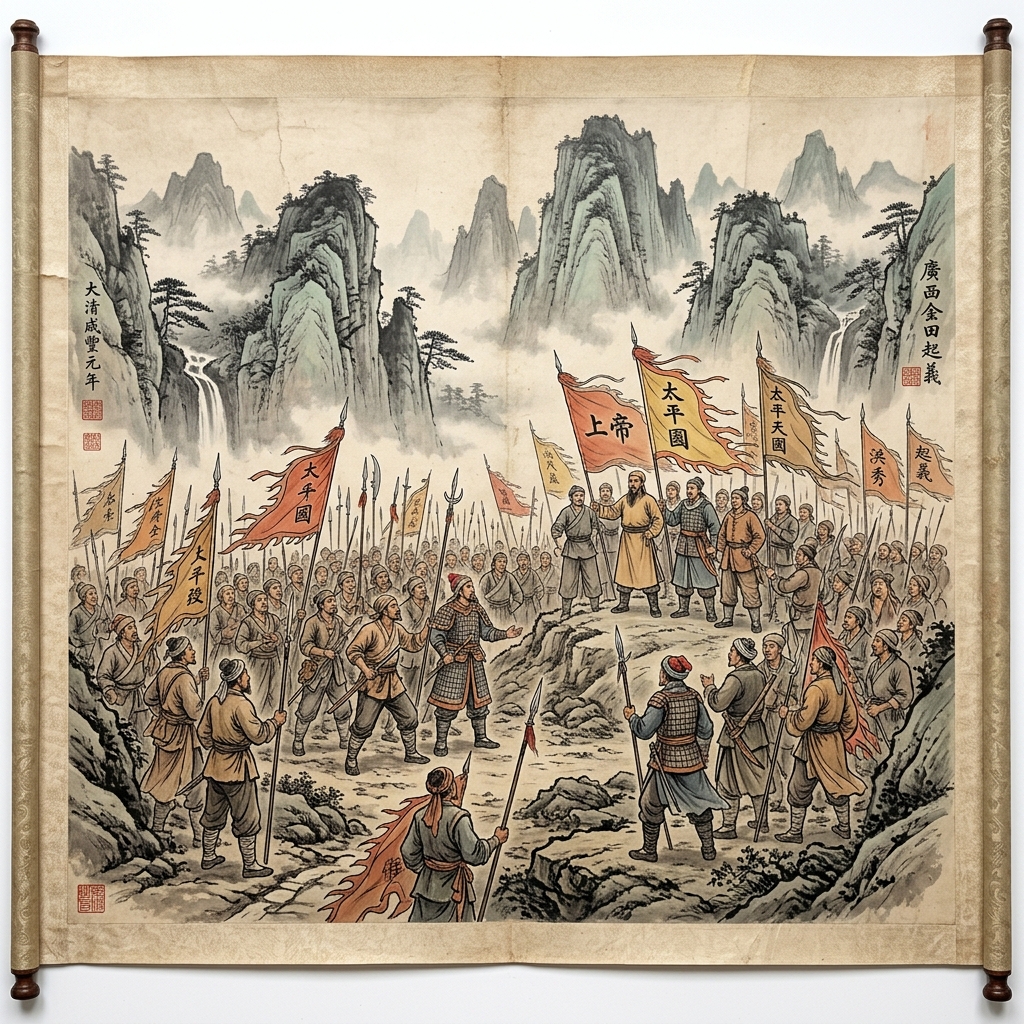
The Jintian Uprising (金田起义, Jīntián qǐyì) on 11 January 1851 marked the Taiping movement's transition from an organized religious society into an armed rebellion against the Qing dynasty. At Jintian village (金田村, Jīntián cūn) in Guiping County, Guangxi, more than 10,000 members of the God Worshipping Society (拜上帝会, Bài Shàngdì Huì) assembled, raised the banner of revolt, and fought their first battle against imperial troops. The uprising was simultaneously a religious convocation, a military mobilization, and a declaration of sacred war — the three threads of Taiping identity woven together from the beginning.[1][2]
Background: The God Worshipping Society in Guangxi
By the late 1840s, Hong Xiuquan (洪秀全), Feng Yunshan (冯云山), and their associates had built a substantial religious community among Hakka settlers, charcoal burners, miners, and impoverished peasants in the Thistle Mountain (紫荆山, Zǐjīngshān) region of eastern Guangxi. The society offered a Christian-influenced monotheism that denounced idols as demons, mutual aid arrangements for members, and an alternative social order in a region troubled by ethnic conflict between Hakka (客家, Kèjiā) and Punti (本地, Běndì) communities, banditry, and weak Qing administration. Feng Yunshan, operating as the society's principal organizer, recruited several thousand members from villages across Guiping, Pingnan (平南), Wuxuan (武宣), and neighboring counties between 1844 and 1847.[2][3]
In 1847–1848, Hong and Feng formalized the society's organization with commandments (十款天条, Shí Kuǎn Tiāntiáo — Ten Heavenly Commandments), worship services on Saturdays, and communal property arrangements. During Hong's temporary absence in early 1848, the future Eastern King Yang Xiuqing (杨秀清) and Western King Xiao Chaogui (萧朝贵) began claiming to speak in the voice of God the Heavenly Father and Jesus Christ respectively during trance states — a practice of spirit-possession (降神, jiàngshén) that would later become central to Taiping state theology and the movement's internal politics.[1][4]
The immediate prelude: late 1850
Throughout 1850, confrontations between God Worshippers and local gentry-led militias intensified. Qing county magistrates, urged by Punti gentry who saw the society as a heterodox threat to social order, dispatched troops to disperse gatherings and arrest leaders. The society's membership was scattered across several counties, vulnerable to piecemeal suppression. Recognizing that disintegration was the alternative to concentration, the leadership issued a call — probably in July or August 1850 — for all members to converge on Jintian village for a collective stand. Believers began arriving in waves through the autumn of 1850, traveling on foot with their families, their livestock, and what weapons they possessed.[2][1]
The mustering was a remarkable act of collective mobilization. Participants sold or abandoned their property before departing — there was no going back. Whole households moved, not just fighting-age men. Some brought swords and spears; charcoal burners and miners brought the tools of their trades, adapted as weapons; a few brought muskets. Weapons were also produced at Jintian itself, with forges established to manufacture spears, swords, and simple firearms. The assembly was not a trained army — it was a community in arms, with women and children alongside men, organized by the village and kinship groups from which the believers had come.[2][3]
The Qing approach
Qing forces in Guangxi in late 1850 were limited and poorly coordinated. The provincial garrison consisted of Green Standard (绿营, Lǜyíng) troops — the regular Chinese military under Manchu-officered provincial command — supplemented by local militia levies. The acting governor of Guangxi, Li Dianyuan (李殿元), commanded the initial response. His forces numbered perhaps a few thousand men, scattered across multiple posts rather than concentrated for a decisive strike. The troops were unfamiliar with Guangxi's densely forested, mountainous terrain and poorly supplied. Intelligence about the God Worshippers' numbers and intentions was fragmentary and contradictory.[1][2]
The terrain around Jintian Village favored the defenders. The village sat in a basin ringed by hills, with the Thistle Mountain massif to the north and the Qian River (黔江, Qián Jiāng) to the south. Approaches were narrow, easily ambushed, and difficult for large formations to negotiate. The assembled believers controlled the high ground and the interior lines of communication. Qing forces attempting to advance on the camp had to move through passes that the God Worshippers' scouts could observe and contest.[1]
The first engagement
By early January 1851, the assembled membership numbered in the tens of thousands, including women and children. Hong Xiuquan, who had been staying in Pingnan County, arrived secretly at the camp. On 11 January 1851 — Hong's thirty-eighth birthday by the Chinese lunar calendar — the assembled believers formally declared rebellion against the Qing dynasty. Hong assumed the title of Heavenly King (天王, Tiānwáng), though the title was not publicly proclaimed until later at Yong'an (永安).[1][2]
The first significant Qing attack came within days of the uprising declaration. A detachment under Li Dianyuan advanced on Jintian and was ambushed and routed by Taiping forces commanded by Yang Xiuqing and Xiao Chaogui at the battle of Caijiang Village (蔡江村). The Qing lost several hundred men; the Taiping captured weapons, supplies, and the morale advantage of an initial victory. The battle demonstrated the tactical pattern that would serve the Taiping well in their early campaigns: draw Qing forces into constricted terrain, ambush them from prepared positions, and exploit the disorganization that followed.[1][2]
Early military organization
At this early stage, the Taiping military organization reflected the society's roots in village and kinship networks. The basic fighting unit was the group of believers from a single village or lineage, commanded by the local leader who had recruited them. Above this level, the five-army system (五军, wǔ jūn) assigned the assembled forces to five commands: Front, Rear, Center, Left, and Right Armies. Yang Xiuqing held overall military command. The organization was improvised — it formalized existing leadership patterns rather than creating new ones — but it provided enough structure to coordinate the army's movements and respond to Qing attacks.[2][1]
Discipline was enforced through a combination of religious authority (violations were offenses against God, not merely against military order), communal solidarity (desertion meant abandoning kin), and harsh punishment. The Taiping's ability to maintain cohesion during the early months — when the army was outnumbered, surrounded, and fighting for its survival — distinguished them from the many local uprisings that Guangxi produced and that Qing forces suppressed without difficulty.[3][2]
Breakout and the march toward Yong'an
Through the spring of 1851, the Taiping army remained mobile within eastern Guangxi, avoiding large Qing concentrations while absorbing new recruits. The emperor in Beijing dismissed the Guangxi governor and appointed Saišangga (赛尚阿), a senior Manchu official, as Imperial Commissioner with broad authority to crush the rebellion. Saišangga brought additional Banner (八旗, Bāqí) troops from the north and adopted a strategy of encirclement — building fortified positions around the Taiping operating area, cutting supply routes, and trying to compel the rebels to fight on Qing terms.[1][2]
In August–September 1851, Taiping forces broke through Qing lines at Guancun (官村) and moved northward. They seized the walled town of Yong'an in late September 1851. The capture of Yong'an was the movement's first major territorial acquisition — the first time the rebels held a county seat with walls, granaries, and administrative buildings. It gave the Taiping a defensible position for the winter months and a setting in which to formalize the leadership structure that would define the movement for the next five years.[2][1][5]
The Yong'an court
At Yong'an, between September 1851 and April 1852, the Taiping formalized the kingship system — naming Hong Xiuquan Heavenly King and his five subordinates as Eastern, Western, Southern, Northern, and Assistant Kings. The full court formation, including each king's role and the institutional precedents set there, is described in Guangxi Campaigns and the Yong'an Period. The formal subordination of the four subordinate kings to Yang Xiuqing — who also claimed to speak for God the Heavenly Father — created a dual structure of sacred and secular authority that contained the seeds of the crisis that would destroy the leadership five years later.[2][5]
The siege and breakout from Yong'an
Saišangga's forces surrounded Yong'an during the winter of 1851–1852, cutting supply routes and repulsing sorties. By April 1852, with food exhausted and the Qing tightening the cordon, the Taiping leadership prepared a breakout. On the night of 5 April 1852, the army evacuated Yong'an under cover of darkness, broke through Qing lines at Gushou (古苏), and began a fighting retreat that carried them out of Guangxi. Luo Ergang notes that this breakout was the first major test of Taiping military discipline under siege conditions, and its success preserved the rebellion when failure would have ended it.[2][1]
The march north and the road to Nanjing
From Yong'an the Taiping marched through northern Guangxi, unsuccessfully besieged Guilin (桂林) for thirty-three days (April–May 1852), moved into Hunan, and laid siege to Changsha (长沙) from September to November 1852 — a campaign that cost the lives of both Feng Yunshan (killed at Quanzhou in May 1852) and Xiao Chaogui (killed at Changsha in September 1852). These losses were severe, but the movement's momentum carried it forward. The army captured ships at Yiyang (益阳) and Yuezhou (岳州), descended the Yangzi River, took Wuchang (武昌) in December 1852–January 1853, and finally captured Nanjing in March 1853. The trajectory from Jintian to Nanjing — a journey of roughly 1,500 kilometers through hostile territory — was completed in just over two years.[1][2][5]
Significance in Taiping ideology and later memory
The Jintian Uprising was the founding moment in Taiping sacred history. The date — the eleventh day of the first month, Hong Xiuquan's birthday — became a liturgical anniversary in the Taiping calendar. Later Taiping texts described the uprising as a divine deliverance: God had gathered his chosen people at Jintian, armed them, and led them to victory. The historical reality was messier — the uprising was simultaneously a religious event, a desperate defensive concentration, and a carefully planned insurrection — but the sacred narrative mattered because it gave the movement a point of origin to which all later Taiping identity could refer.[4][2]
After 1949, PRC historians elevated the Jintian Uprising as the founding act of a peasant revolution, tracing a lineage from Jintian to the Chinese Communist revolution. The political framing has shaped Chinese-language scholarship on the event for decades, though more recent work has sought to disentangle the historical Jintian from its ideological appropriations.[2][5]
Debates
Scholars debate the Jintian Uprising's internal dynamics. One view, associated with Luo Ergang's early work, treats the uprising as a planned insurrection — the result of at least a year of military preparation, including weapons stockpiling, training, and secret communications among the scattered God Worshipper communities. An alternative view emphasizes spontaneity: the congregation at Jintian, in this reading, was a defensive response to Qing repression rather than the execution of a pre-existing plan. The question matters because it bears on whether the Taiping movement was from its inception a would-be state or a religious community forced into rebellion.[2][3]
A related debate concerns numbers. Luo Ergang's estimate of over 10,000 participants at Jintian has been challenged by scholars who argue, based on Qing intelligence reports preserved in the First Historical Archives, that the fighting force at the moment of uprising may have been closer to 5,000–7,000, with the rest comprising family members and camp followers. The larger figure is plausible if one counts the entire assembled community; the smaller figure reflects the stricter criterion of armed combatants. Both estimates involve significant uncertainty, since no reliable census of the Jintian gathering exists.[2][3]
A third debate concerns the social composition of the uprising. Some scholarship emphasizes class (poor peasants, miners, charcoal burners); other work emphasizes ethnicity (the Hakka identity shared by most participants). Kuhn's analysis of Guangxi's local militarization suggests that the God Worshippers were only one of several armed societies in the region; the Taiping's distinctive ideological discipline — their shared religious identity — not raw numbers or class composition, determined their capacity to survive and grow when other local rebellions were crushed.[3]
Related pages
Sources Used in This Page
- Franz Michael, The Taiping Rebellion: History and Documents, Vol. I (Seattle: University of Washington Press, 1966).
- Philip A. Kuhn, Rebellion and Its Enemies in Late Imperial China (Cambridge, MA: Harvard University Press, 1970).
- Luo Ergang 罗尔纲, Taiping tianguo shi 太平天国史 (Beijing: Zhonghua Shuju, 1991).
- Mao Jiaqi 茅家琦, Taiping tianguo tongshi 太平天国通史 (Nanjing: Nanjing daxue chubanshe, 1991).
- Thomas H. Reilly, The Taiping Heavenly Kingdom (Seattle: University of Washington Press, 2004).
Read Next
- The Taiping Heavenly Kingdom — How the movement became a state.
- Tianjing Incident — The leadership catastrophe that followed.