!Traditional Chinese painting of the Ever-Victorious Army drilling in the 1860s
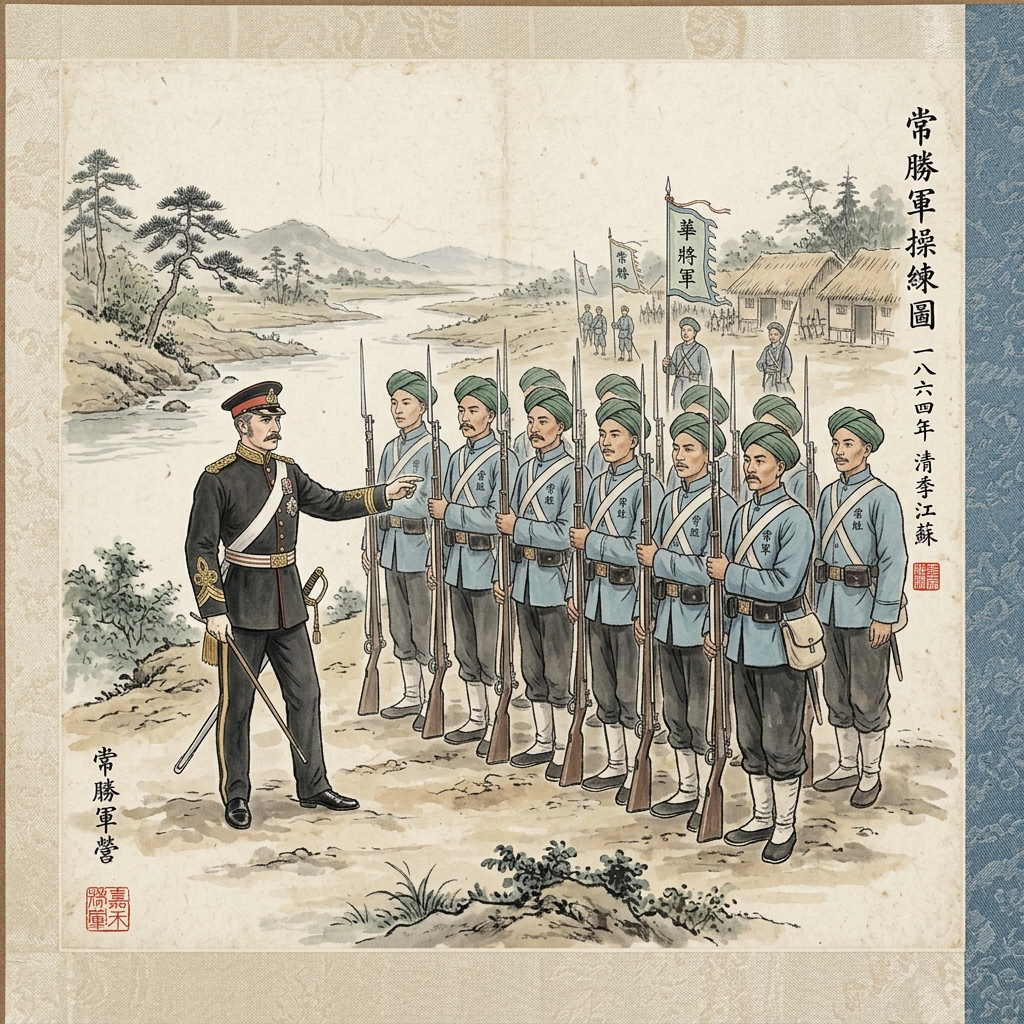
The Ever Victorious Army, 常胜军 (Chángshèng jūn), was a Qing auxiliary force that operated in the Shanghai and lower Yangzi theater from 1860 to 1864. It is best known for its foreign officers — Frederick Townsend Ward, an American adventurer, and Charles Gordon, a British army engineer — but the force was always Chinese in its rank and file, Chinese-funded, and subordinate to Qing provincial authority. It was tactically important in the Shanghai region but should not be credited with deciding the outcome of the Taiping war. Its real historical significance lies in what it demonstrated: that Chinese soldiers, drilled by foreign officers and armed with Western weapons, could fight with an effectiveness that matched or exceeded traditional Qing forces.[1][2]
Ward: adventurer and mercenary
Frederick Townsend Ward (1831–1862) was born in Salem, Massachusetts, the son of a shipmaster. He went to sea as a teenager and fought — in various capacities — in Mexico, in William Walker's filibustering expeditions in Nicaragua, and with the French army in the Crimean War. By 1860, aged twenty-nine, he had acquired military experience on three continents, a taste for adventure, and no fixed loyalties to any government. He arrived in Shanghai in 1860, looking for opportunity.
When Taiping forces under Li Xiucheng (李秀成) threatened Shanghai that year, Ward saw his opening. Shanghai's merchants — both Chinese and foreign — were terrified of a Taiping occupation that would destroy trade and property. Ward proposed to raise and command a foreign-led force to defend the city, funded by Shanghai commercial interests and authorized by Qing officials.[1]
The first force and its failure
Ward's first attempt was a disaster. In late 1860 he recruited perhaps 100 to 200 foreign volunteers — discharged sailors, drifters, and adventurers drawn from the treaty-port docks — and led them against Taiping positions near Songjiang (松江). The foreign mercenaries, many of them drunk and undisciplined, broke under fire. Ward was wounded, and his force disintegrated.
Ward learned from the failure. The lesson was that foreign mercenaries were unreliable. The solution — whether original to Ward or suggested by his Chinese backers — was to recruit Chinese soldiers, train them to Western drill and fire discipline, arm them with modern rifles, and command them through foreign officers who could enforce standards that Qing Green Standard officers could not.[1]
Reorganization and success
The new formula worked. Ward established a training camp near Shanghai and recruited Chinese soldiers from the lower Yangzi region — many of them displaced men seeking employment, others drawn from fishermen and boatmen familiar with the waterways. They were drilled in European infantry tactics, taught to fire in volleys, and paid substantially more than Green Standard soldiers. The foreign officers — Ward himself, plus a cadre of Americans, Britons, and Europeans of various backgrounds — provided command at the company and battalion level.
In July 1861, Ward's reorganized force captured Songjiang, a strategically important town southwest of Shanghai that the Taiping had held. He held it against counterattacks. For these successes the Qing court granted the unit the honorary title "Ever Victorious Army" and awarded Ward official Chinese rank — eventually reaching the grade of brigadier-general (总兵, zǒngbīng).[1]
Ward's forces took Jiading (嘉定) and Qingpu (青浦) in early 1862, in operations that combined Western-style infantry assault with amphibious movement by canal and river. In May 1862, they participated in the defense of Shanghai during Li Xiucheng's major offensive, fighting alongside Li Hongzhang's newly arrived Huai Army and British and French naval detachments. Ward's forces also operated in the Ningbo (宁波) theater in Zhejiang, where French naval forces under Admiral Auguste Protet were also active. At the Battle of Cixi in September 1862, Ward led his troops against a walled Taiping position south of Ningbo.[1][2]
Ward's death at Cixi
Ward was killed on 21 September 1862 while leading the assault on the walled town of Cixi (慈溪), south of Ningbo. He was shot in the abdomen while directing his troops near the city gate and died within hours. He was thirty-one years old.
By the time of his death, Ward had accumulated a remarkable portfolio of Chinese connections. He had married Chang Meiyu (章美玉), the daughter of a Shanghai comprador. He had converted to Catholicism — his baptism was arranged by a French missionary — reportedly to facilitate relations with French military authorities in Zhejiang. He had accepted Qing rank and commanded Chinese troops for two years. His memorial temple was established at Songjiang by Qing order. Ward was not simply a foreign mercenary; he had become, in the peculiar circumstances of the treaty-port world, a figure who bridged multiple communities. After his death, the Qing court granted him the posthumous rank of provincial commander-in-chief (提督, tídū) and provided a pension to his widow.[1]
Burgevine's disastrous interlude
Ward's death created a command crisis. Henry Andres Burgevine (1836–1865), an American who had served as Ward's second-in-command, assumed temporary leadership. Burgevine was aggressive in combat but had neither Ward's diplomatic skill nor his ability to manage relations with Qing officials. He quarreled with Yang Fang (杨坊), the Shanghai banker who managed the force's finances, over pay and supplies. When funds were delayed, Burgevine led a group of armed foreign officers to Yang's residence in January 1863, assaulted him physically, and seized the treasury chest. Qing authorities dismissed him and stripped him of his rank.
Burgevine's subsequent trajectory was dark. He attempted to join the Taiping and offered them his services — an act that made him a traitor to the Qing state. The Taiping declined his offer. He was later captured by Qing forces and drowned — officially an accident — while being transported under guard in 1865. Burgevine's story illustrated the vulnerability of the foreign-commanded force to the personality and character of its commander.[1][2]
Gordon: the reluctant imperial servant
Charles George Gordon (1833–1885) was, by temperament and background, the opposite of Ward. Born in Woolwich to a military family, Gordon was commissioned in the Royal Engineers in 1852. He served in the Crimean War (1853–1856), where he acquired a reputation for courage and competence, especially in the construction of trenches and fortifications during the siege of Sevastopol. He was posted to China during the Second Opium War in 1860, where he participated in the occupation of Beijing and witnessed the burning of the Summer Palace (圆明园, Yuánmíngyuán) — an event he later regretted deeply.
When the British government decided to support Qing forces more actively in 1863, Gordon was proposed as the new commander of the Ever Victorious Army. He was appointed in March 1863, with the formal title of commander of the force under Li Hongzhang's authority. Gordon accepted on the condition that he receive no payment beyond his British Army half-pay — a decision that reflected his Victorian sense of honor and that made him, in Qing eyes, a peculiar figure indeed.[1]
Gordon's reforms
Gordon found the Ever Victorious Army dispirited by Burgevine's misrule, demoralized by pay arrears, and frayed by months of uncertain command. He reorganized the force, reducing the officer corps to reliable men, reestablishing regular pay, and imposing tight discipline. He cultivated personal loyalty from the rank and file by visiting the wounded, sharing the soldiers' hardships, and leading from the front — a style of command that Chinese soldiers, accustomed to the distance between officers and men in traditional Chinese armies, found striking.
But Gordon was not a soft commander. He executed deserters, flogged insubordinates, and demanded standards of drill and conduct that had been absent under previous commanders. The combination of personal concern and iron discipline — what might be called Victorian paternalism — proved effective. By the spring of 1863, the force was ready for offensive operations. Gordon also improved the force's logistics, establishing supply depots, purchasing steamboats for troop transport, and standardizing ammunition and weaponry.[1]
Key Gordon campaigns
Gordon's first major operation was the capture of Kunshan (昆山) in May–June 1863. Kunshan was a fortified town on the Suzhou Creek, protected by stone walls and water defenses. Gordon used steamboats to transport troops and artillery through canal networks that Taiping defenders had considered impassable. A surprise attack from the waterways, supported by concentrated artillery fire, broke the Taiping defenses. The Kunshan operation demonstrated Gordon's skill at using the river-and-canal geography of the lower Yangzi to tactical advantage.[1]
The next target was Suzhou (苏州), the great walled city that had been the cultural and economic capital of the lower Yangzi for centuries and was now Li Xiucheng's regional headquarters. The siege of Suzhou lasted from July to December 1863. Gordon's forces captured outlying positions — Taicang, Wujiang, and others — and invested the city itself. The siege was a grinding operation combining artillery bombardment, infantry assault, and the slow strangulation of supply lines. The capture of Suzhou was one of the most important Qing victories of the war, rivaled only by the fall of Anqing (1861) and the final capture of Nanjing (1864).[1][2]
After Suzhou, Gordon's forces pushed westward to Changzhou (常州), which fell in May 1864 after heavy fighting. By this point, the Xiang Army under Zeng Guoquan was closing on Nanjing from the north and west, and the Ever Victorious Army's operations were winding down. The force was formally disbanded in May 1864, two months before the final fall of Nanjing on 19 July.[1]
The Suzhou crisis and the clash of moralities
The Suzhou operation exposed the deepest tension in joint Sino-foreign command. After weeks of siege, several Taiping commanders inside Suzhou — most notably the eight Wang (王, "kings") who controlled the city's defense — opened surrender negotiations with Gordon through intermediaries. Gordon offered them safe conduct in exchange for the peaceful handover of the city. They accepted.
When Suzhou fell on 5 December 1863, Li Hongzhang ordered the execution of the surrendered Taiping commanders. Gordon considered this a breach of the terms he had personally guaranteed and a stain on his personal honor. He armed himself, went to confront Li Hongzhang, and threatened to resign. For several weeks he refused further cooperation. The crisis was resolved through the intervention of British consular authorities and the Shanghai diplomatic community, who pressed Gordon to resume command for the sake of the larger anti-Taiping effort.
The episode reveals a fundamental cultural and institutional conflict. Gordon operated on a code of personal honor rooted in Victorian military professionalism — a prisoner who surrenders on terms is owed those terms. Li Hongzhang operated on a Qing tradition in which rebels were traitors entitled to no quarter, and military necessity overrode any promise made to an enemy. Neither man was insincere; they inhabited different moral and political universes. The crisis demonstrated that the Ever Victorious Army was ultimately a Qing force, and its foreign commander could not impose his own terms on Qing provincial authority.[1][3][2]
Scale and significance
The Ever Victorious Army numbered perhaps 3,000 to 5,000 men at its peak — small compared to the Xiang Army's tens of thousands or the Taiping armies that numbered in the hundreds of thousands. It operated in a single theater, the lower Yangzi and the Suzhou-Shanghai corridor. It was well-armed and tactically effective in its region, but it did not determine the outcome of the wider war. Zeng Guofan's Xiang Army, grinding through years of siege along the middle Yangzi, remained the decisive Qing military instrument.
The Ever Victorious Army's significance lies in what it represented: the first sustained instance of Sino-foreign military cooperation against the Taiping, a model for using foreign officers to train and lead Chinese troops, and a demonstration of how Western weapons and drill could enhance provincial forces. Li Hongzhang absorbed these lessons and applied them to the Huai Army's modernization in the 1860s and 1870s. The force was a tactical asset; the model was a strategic legacy.[4][2]
Aftermath
The Ever Victorious Army was disbanded in May 1864, before the fall of Nanjing. Some of its Chinese soldiers were absorbed into the Huai Army; most returned to civilian life. Its foreign officers scattered — some to other Chinese posts, some home, some to further adventures in Asia and Africa.
Gordon returned to Britain, where his Chinese service — magnified by Andrew Wilson's 1868 book The Ever-Victorious Army — made him a Victorian hero, celebrated as "Chinese Gordon." He was appointed governor of Equatoria in the Egyptian Sudan (1874–1879) and later governor-general of the Sudan, where he was killed by Mahdist forces at Khartoum on 26 January 1885 — two days before a British relief expedition arrived. The Gordon legend became a fixture of British imperial memory, and his death triggered political crisis in London, contributing to the fall of Gladstone's government. The Western fascination with Gordon's story permanently distorted Western understanding of the Taiping war, elevating a secondary figure to central importance.[1]
Ward's memory persisted in Shanghai, where his memorial temple stood in the former French Concession until the mid-twentieth century. His widow, Chang Meiyu, received a Qing pension. Burgevine was largely forgotten — an embarrassment to all sides, a cautionary tale of mercenary ambition without the political skill to sustain it.
Debates
Scholars debate the tactical significance of the Ever Victorious Army. Nineteenth-century British accounts, especially Wilson, credited Gordon with innovations in amphibious assault, artillery concentration, and coordinated infantry-artillery operations. More recent scholarship suggests that these techniques were already known to other foreign officers in China and that Gordon's distinctive contribution was logistical competence and disciplinary reform rather than tactical invention.[2]
A larger debate concerns the force's contribution to Qing victory. Wilson and other Victorian writers exaggerated the role of foreign-commanded units, presenting Gordon as the savior of the dynasty. This view — which reflected British imperial self-regard more than military reality — has been thoroughly revised. The Taiping were defeated primarily by Chinese provincial armies, numbering in the tens and eventually hundreds of thousands, not by a few thousand foreign-led auxiliaries. Yet the theater in which the Ever Victorious Army operated mattered disproportionately: securing Shanghai and the Suzhou corridor preserved Qing access to customs revenue and prevented the Taiping from consolidating a coastal base that could have drawn on foreign trade and prolonged the war.[4][3]
A third debate concerns the morality of the force. Was it a legitimate auxiliary to a legitimate government, or a mercenary instrument of foreign imperial interest? The answer depends partly on one's view of the Qing-Taiping conflict itself. If the Qing were the legitimate government, the Ever Victorious Army was a hired auxiliary defending a sovereign state; if the Taiping cause was legitimate, the force was an instrument of counterrevolution. Most scholarship accepts the former framing while acknowledging the force's role in advancing foreign commercial interests in the Yangzi valley. The Suzhou massacre crystallizes this debate: Gordon's moral code was violated, but Li Hongzhang's was upheld — and it was Li Hongzhang's authority that was sovereign on the ground.[2]
Related pages
- Li Hongzhang
- Qing Commanders at War
- Shanghai and Lower Yangzi
- Foreign Relations and Intervention
- Qing Counterinsurgency
Sources used in this page
- Andrew Wilson, The Ever-Victorious Army: A History of the Chinese Campaign under Lt. Col. C. G. Gordon (Blackwood, 1868). The primary English-language contemporary account; invaluable but shaped by a British military and imperial perspective.
- Franz Michael, The Taiping Rebellion: History and Documents, Vol. I (1966). Campaign narrative and context.
- Philip A. Kuhn, Rebellion and Its Enemies in Late Imperial China (1970). Context on provincial militarization and the Qing response.
- Luo Ergang, 《太平天国史》 (1991). Chinese-language military history perspective.