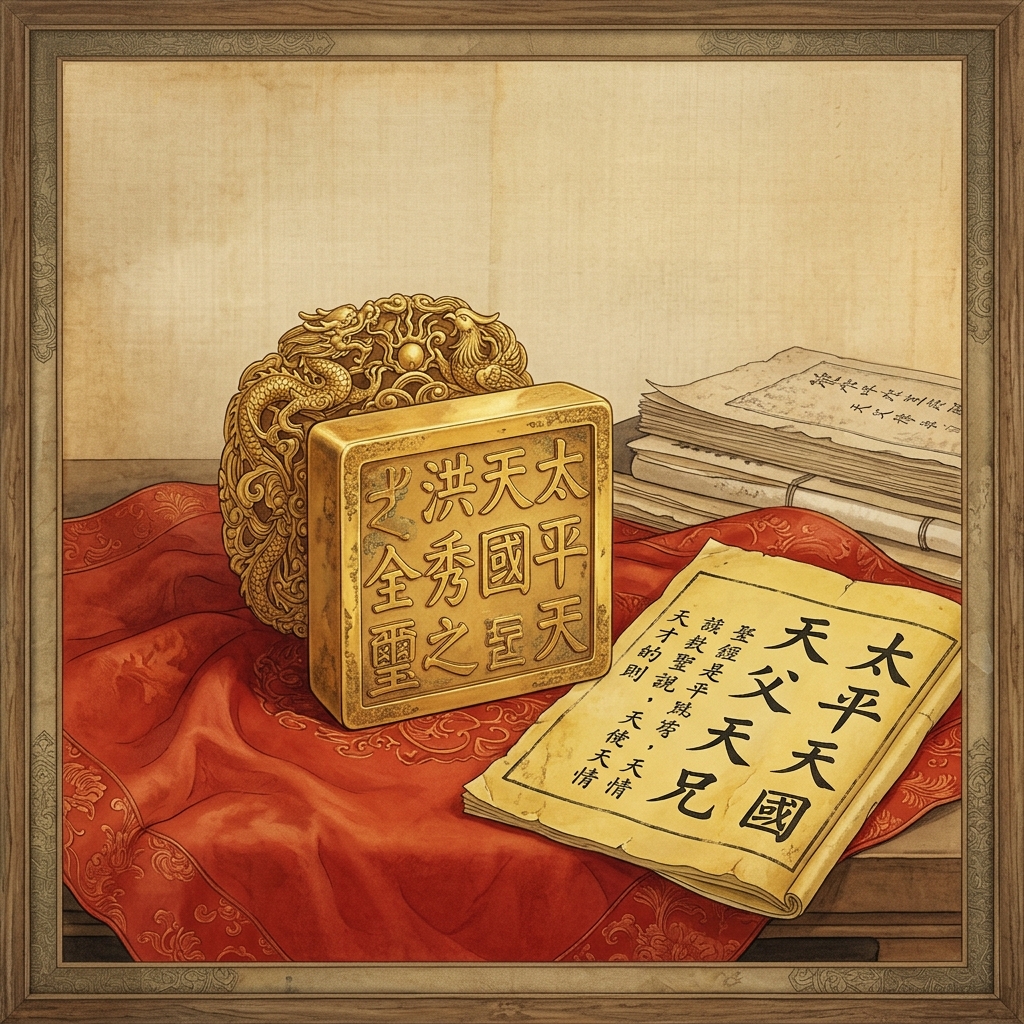
The Taiping Heavenly Kingdom, 太平天国 (Tàipíng Tiānguó), was the largest alternative state erected on Chinese territory between the Ming-Qing transition and the 1911 revolution. It was simultaneously a religious kingdom, a rebel regime, and a government at war — a state that produced its own sacred texts, calendar, civil examinations, and land system while fighting for survival against the Qing empire.[1][2]
Founding
The kingdom began in rebellion. On 11 January 1851, at Jintian village, 金田村, in Guangxi, the God Worshippers raised the standard of rebellion. Hong Xiuquan assumed the title Heavenly King, 天王 (Tiānwáng). In September 1851, the Taiping army captured the prefectural city of Yong'an, 永安, and there the movement gave itself a court structure: Yang Xiuqing was named Eastern King, 东王 (Dōngwáng); Xiao Chaogui, Western King, 西王 (Xīwáng); Feng Yunshan, Southern King, 南王 (Nánwáng); Wei Changhui, Northern King, 北王 (Běiwáng); and Shi Dakai, Wing King, 翼王 (Yìwáng). This act transformed a religious uprising into a would-be dynasty.[1][3]
After the capture of Nanjing on 19 March 1853, the kingdom gained a capital and a territorial base in the lower Yangzi. The city was renamed Tianjing, 天京 ("Heavenly Capital"). Hong took up residence in the former Governor-General's yamen, now the Heavenly King's Palace, 天王府 (Tiānwángfǔ). The court began issuing proclamations, printing books, appointing officials, collecting taxes, and governing — as a state, not merely an army.[1]
State structure: kings, officials, ministries
The Taiping state was headed by the Heavenly King, who combined sacred and political authority. Below him stood a hierarchy of kings — initially the five named at Yong'an, later expanded as the regime appointed new kings to reward commanders and manage the growing state. By the 1860s, the proliferation of royal titles — over 2,700 in some estimates — had debased the currency and created confusion.[3]
The Eastern King, Yang Xiuqing, was the effective head of government until his death in 1856. He commanded the military and supervised the civil administration. After the Tianjing Incident, Hong assumed direct control, delegating to Hong Rengan (who arrived in 1859 and was named Shield King, 干王, Gānwáng) and to the military commanders Li Xiucheng and Chen Yucheng.[4]
The Taiping established ministries on a military-administrative model. Each king maintained his own departmental structure. The system was personalistic — officials reported to kings, not to abstract offices. This gave the regime flexibility but also made it vulnerable to court politics.[3]
The official book publication system
One of the Taiping state's most distinctive institutions was 印书 (yìnshū), the system for publishing official texts. The Taiping were prolific publishers. Their printed output included:
- Religious texts: the Taiping Bible editions, the 天条书 (Tiāntiáo shū, "Book of Heavenly Commandments"), the 三字经 (Sānzìjīng, "Trimetrical Classic"), and 幼学诗 (Yòuxuéshī, "Poems for Youth")
- Political proclamations: Hong's early essays collected as the 太平诏书 (Tàipíng zhàoshū), the 天朝田亩制度 (Tiāncháo tiánmǔ zhìdù), Yang's decrees, and Hong Rengan's 资政新篇 (Zīzhèng xīnpiān)
- Official documents: military regulations, tax certificates, land titles, and identity papers[4]
The printing was done in Tianjing at state workshops using woodblock and movable-type technology. Books were distributed to officials, officers, worship halls, and examination candidates. The book production system was simultaneously a propaganda apparatus, a religious ministry, and an administrative tool. It gave the Taiping state a textual presence that distinguished it from more ephemeral rebellions.[4]
Calendar reform
The Taiping replaced the Qing lunar calendar with their own calendar, the 天历 (Tiānlì, "Heavenly Calendar"). Promulgated in 1852, the Heavenly Calendar was a solar calendar with 366 days per year, 12 months of 30 or 31 days, and a consistent seven-day week ending with the sabbath on Saturday. Leap days were handled differently from the Qing calendar.[4][3]
The calendar served several functions. It marked the Taiping's independence from Qing time-reckoning — the Qing calendar was a symbol of imperial authority, and replacing it was a political act. It aligned time with the sabbath cycle, ensuring that every seventh day fell on Saturday for worship. It eliminated the Qing calendar's astrological and geomantic content, which the Taiping regarded as superstitious. And it provided a standard framework for official dates, tax collection, and military operations.[2]
The Heavenly Calendar proved difficult to maintain. The 366-day year drifted relative to the solar year, causing seasonal misalignment over time. After the Taiping's fall, Li Xiucheng's confession noted calendar confusion as one of the regime's minor but persistent administrative problems.[3]
Civil examination system
The Taiping established their own civil service examinations, modelled on — and competing with — the Qing examination system. The examinations were held at county, prefectural, provincial, and capital levels. Candidates were tested on Taiping sacred texts, proclamations, and doctrines rather than the Confucian classics. The aim was to produce officials loyal to the Heavenly Kingdom and versed in its ideology.[4][3]
Women were theoretically eligible to sit for the examinations, and the Taiping appointed some female degree-holders — a departure from Qing practice, where the examinations were exclusively male. The extent of female participation is unclear, but the principle itself was striking.[3]
The examination system was never fully institutionalised. War interrupted the examination cycle, qualified examiners were scarce, and the pool of educated candidates willing to sit for Taiping examinations was limited. Many scholar-gentry families either fled Taiping territory or passively resisted. The examinations functioned more as a recruitment device for loyalists and a propaganda statement than as a systematic pipeline for talent.[3]
Relations with rural society
The Taiping state's relationship with rural society was complex and varied by region. In some areas, the Taiping won local support by lowering taxes, suppressing bandits, and providing security — at least temporarily. In others, temple destruction, sex-separation policies, labour requisitions, and confiscations alienated the population.[5][6]
The gentry — the traditional local elite — were the Taiping's most consistent opponents. The Taiping attacked the ideological basis of gentry authority: Confucian learning (replaced by Taiping scripture), lineage ritual (condemned as idolatry), and landholding (threatened by the Land System). Gentries organised militia, financed Qing armies, and provided the personnel for the Qing counteroffensive. Kuhn's analysis of the militarisation of the gentry — the formation of local militia and regional armies — shows how the Qing state's survival depended on gentry mobilisation against the Taiping.[5]
Rural communities that were neither strongly pro-Taiping nor anti-Taiping faced a world of fluid, violent uncertainty. A village might pay taxes to Taiping officials one month and to Qing militia the next. A family might lose a son to Taiping conscription and a daughter to Qing reprisal. Meyer-Fong's study of the war's human cost documents how ordinary people navigated — and suffered — the presence of two competing states on the same land.[6]
Related pages
- Tianjing
- Civil Administration
- Land System
- New Treatise
- Military Organization
- Taiping Law and Discipline
- Economy and Taxation
Sources used in this page
- Franz Michael, The Taiping Rebellion: History and Documents, Vols. I, II (Seattle: University of Washington Press, 1966, 1971).
- Luo Ergang 罗尔纲, Taiping Tianguo shi 太平天国史 (Beijing: Zhonghua shuju, 1991).
- Thomas H. Reilly, The Taiping Heavenly Kingdom (Seattle: University of Washington Press, 2004).
- Philip A. Kuhn, Rebellion and Its Enemies in Late Imperial China (Cambridge, MA: Harvard University Press, 1970).
- Tobie Meyer-Fong, What Remains (Stanford: Stanford University Press, 2013).