!Traditional Chinese ink painting of Tianjing (Nanjing) on the Yangzi River under Taiping rule
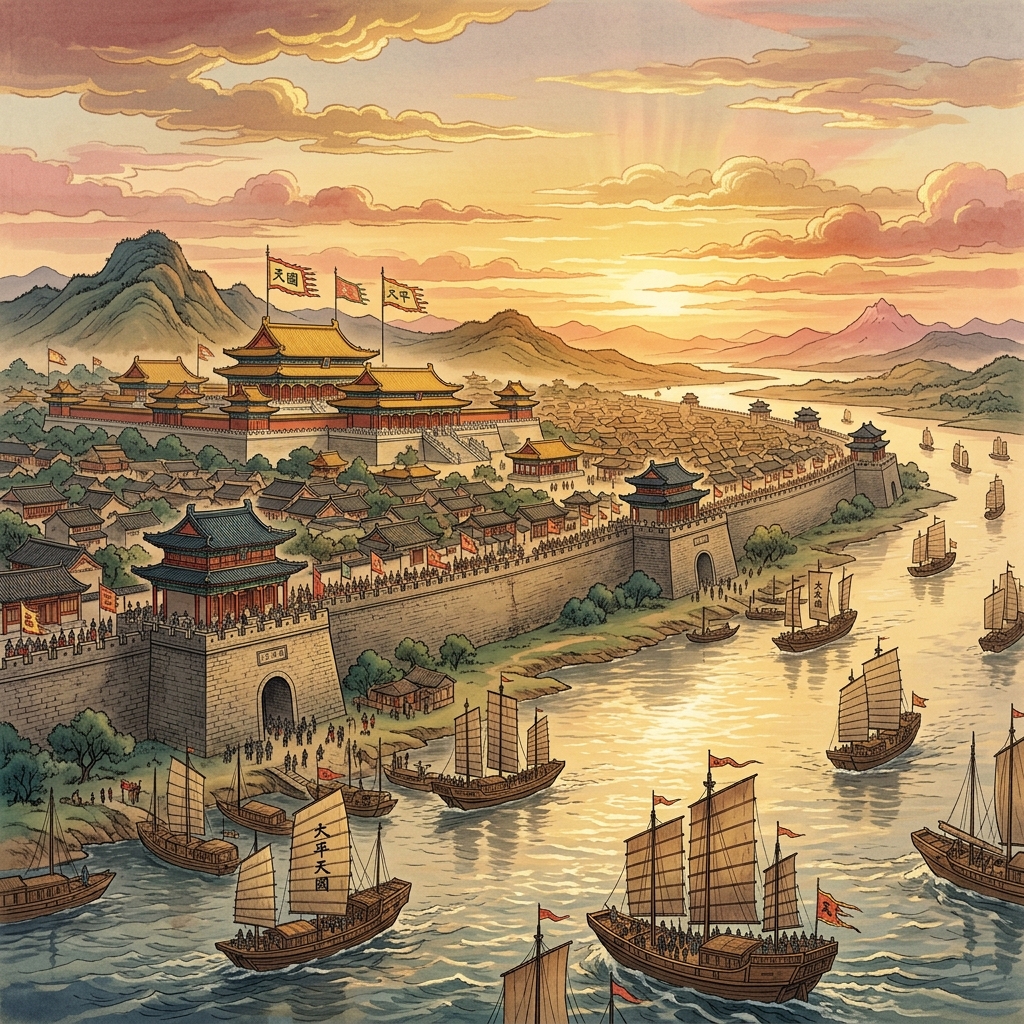
Tianjing, 天京 (Tiānjīng, "Heavenly Capital"), was the Taiping name for Nanjing, 南京, after its capture on 19 March 1853. The city served as the capital of the Heavenly Kingdom for eleven years — the residence of Hong Xiuquan, the centre of court politics, the seat of the Sacred Treasury and book-printing system, and the final target of the Qing siege that destroyed the Taiping state.[1][2]
Capture and renaming
The Taiping moved down the Yangzi in late 1852 and early 1853, capturing Wuchang, 武昌, in December 1852, then advancing through Jiujiang, 九江, and Anqing, 安庆. Nanjing fell on 19 March 1853 after a brief siege. The city's walls — among the longest and strongest in China — made it a formidable fortress. Its position on the lower Yangzi gave the Taiping control of river traffic and access to some of China's richest agricultural and commercial territory.[1]
The renaming from Nanjing, "Southern Capital," to Tianjing, "Heavenly Capital," was a political claim. Nanjing had been the capital of the early Ming dynasty and the base of the southern Ming resistance. The Taiping's choice of capital invoked that history while declaring that the city now belonged to a new, sacred order. The Qing continued to call the city Nanjing and referred to the Taiping regime as the "Yue bandits," 粤匪 — language that denied the Taiping any legitimacy.[2]
Layout and transformation
The Taiping transformed Nanjing into Tianjing through a programme of renaming, reconstruction, and repurposing. The city's landmarks were given new Taiping names. The Governor-General's yamen, 总督衙门, became the Heavenly King's Palace, 天王府 (Tiānwángfǔ). Existing temples, monasteries, and ancestral halls were destroyed or converted to Taiping uses — worship halls, barracks, workshops, and offices.[3]
The population of Tianjing was reorganised along Taiping lines. Men and women were segregated into separate quarters — men's camps (男馆, nánguǎn) and women's camps (女馆, nǚguǎn). The urban population was assigned to military-administrative units under Taiping officers. Private trade was suppressed in the early years — a reflection of the Sacred Treasury ideal — though markets gradually re-emerged as the regime adapted to necessity.[2][4]
The Taiping court occupied the centre of the city. The Heavenly King's Palace was a vast compound — reportedly larger than the Forbidden City in some descriptions, though such claims were likely exaggerated — containing ceremonial halls, living quarters for Hong and his consorts, offices for the palace bureaucracy, and spaces for religious rituals. The Eastern King's Palace, Western King's Palace, and residences of other high officials surrounded the centre.[2]
Meyer-Fong notes that the Taiping transformation of Nanjing was physical as well as ideological: the destruction of temples and ancestral halls erased the city's pre-Taiping sacred landscape; the construction of Taiping buildings imposed a new spatial order; and the city's siege-related destruction, especially between 1862 and 1864, left scars that persisted for decades.[3]
Life in the capital
Life in Tianjing was highly regulated. The population was subject to Taiping law, sabbath observance, moral rules, and military discipline. Rations were distributed from the Sacred Treasury. Worship was compulsory. Idolatry was punished. The Ten Heavenly Rules governed conduct.[5]
Conditions deteriorated over time. In the early years (1853–1856), the Taiping capital was relatively well-supplied — tribute and taxes from the lower Yangzi sustained the court and population. After the Tianjing Incident of 1856, and especially after the Qing retook Anqing in 1861 and tightened the siege, supplies dwindled. By 1863–1864, the city was starving. Accounts of the final siege describe residents eating grass, roots, and eventually human flesh. Lindley, who visited Tianjing in the early 1860s, described a city already showing signs of strain but still functioning.[6][3]
The contrast between the court's luxury and the population's suffering became acute in the final years. Hong Xiuquan reportedly continued to issue religious proclamations about heavenly manna and divine protection even as his subjects starved. Li Xiucheng's confession describes a monarch increasingly detached from material reality, sustained by visions, while his capital collapsed around him.[2]
Siege and fall
Qing forces under Zeng Guofan, 曾国藩, and his brother Zeng Guoquan, 曾国荃, tightened the siege of Tianjing from 1862. The city's walls, formidable against traditional assault, were subjected to systematic siege warfare — trenches, earthworks, mining, and bombardment. Taiping attempts to break the siege — including Li Xiucheng's efforts to relieve the city — failed.[1]
Hong Xiuquan died on 1 June 1864. The cause of death is disputed: most Western sources say suicide by poison; some Chinese sources suggest illness. He was buried inside the palace, and his body was later exhumed, identified, and burned by Qing forces.[2]
The city fell on 19 July 1864. Qing troops breached the walls near the Taiping Gate, 太平门. The sack that followed was devastating. Tens of thousands of Taiping defenders and civilians were killed. Li Xiucheng, captured while trying to escort Hong's young son — the infant Heavenly King, 幼天王 (Yòu Tiānwáng) — out of the city, was executed after writing his confession. Hong's son was captured shortly afterward and executed. The city burned. Zeng Guofan ordered the systematic destruction of Taiping buildings and records.[3][1]
Tianjing after 1864
The physical destruction of Tianjing was followed by Qing reconstruction. Temples were rebuilt, the examination system restored, and the city reintegrated into the imperial order. But the human and material cost of the sack persisted. Meyer-Fong's study of the city's post-war landscape describes years of rubble, mass graves, haunted memory, and the slow, contested process of rebuilding both buildings and lives.[3]
Tianjing was both the proof and the tragedy of the Taiping experiment. For eleven years it served as the stage on which the Heavenly Kingdom enacted its most radical social and religious programmes — sex segregation, temple destruction, public worship, and sacred kingship. Its fall in July 1864 marked not only the military end of the Taiping state but the erasure of a would-be sacred order from the Chinese landscape.
Related pages
Sources used in this page
- Franz Michael, The Taiping Rebellion: History and Documents, Vols. I, II (Seattle: University of Washington Press, 1966, 1971).
- Luo Ergang 罗尔纲, Taiping Tianguo shi 太平天国史 (Beijing: Zhonghua shuju, 1991).
- Tobie Meyer-Fong, What Remains: Coming to Terms with Civil War in 19th Century China (Stanford: Stanford University Press, 2013).
- Thomas H. Reilly, The Taiping Heavenly Kingdom (Seattle: University of Washington Press, 2004).
- Augustus F. Lindley, Ti-ping Tien-kwoh (London: Day & Son, 1866).